Showing posts with label Merovingian. Show all posts

Friday, April 26, 2024

Delegate of the Gallican Rite Appointed in France

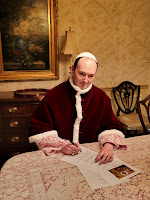
Mons. Hugo-Marie
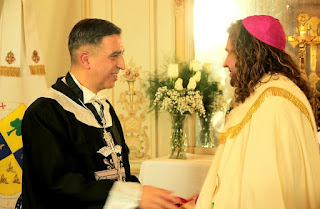
M. Derosiers

MAYENNE 26 April 2024 (NRom)

In a move that underscores the deep reverence for tradition, His Excellency Archbishop Alejandro Paolo, Archbishop of Lyon and Primate of the Catholic Church of the Gallican Rite, appointed Monsignor Hugo-Marie as the Delegate of the Primate in France. This significant appointment, made on 25 April 2024, the Feast of St. Mark the Evangelist, marks a pivotal moment in the Church's history, highlighting the ongoing commitment to the Gallican Rite, one of the United Roman-Ruthenian Church's principal rites with a rich and diverse heritage. 

The appointment of Monsignor Hugo-Marie by Archbishop Alejandro Paolo received confirmation from Sire Rubén, head of the Royal Merovingian Dynasty, and from the Bishop of Rome-Ruthenia. This double-confirmation underscores the unique position of the Gallican Rite within the Church, weaving together ecclesiastical authority of the Archbishop of Lyon with the temporal protection of the Royal Merovingian Dynasty. The co-involvement of these distinct yet interconnected authorities highlights the Gallican Rite's historical and contemporary significance.

Mons. Hugo-Marie, based at the Chapel of the Holy Family and St. Louis in the region of Mayenne, France, now assumes a role of great importance. His primary responsibility as the Delegate of the Primate in France involves not only administrative duties but also, and perhaps more importantly, the preservation and promotion of the ancient Gallican liturgy directly within the French territory. This liturgy, characterized by its ancient roots and eastern influences, represents a vital link to the Church's past and a beacon for its future.

Although the ancient Gallican liturgy is a Western liturgy, its origins and practices maintain a significant Eastern influence. This unique blend of traditions is a reminder of the universality of the Christian faith, transcending geographical and cultural boundaries. The liturgy itself was founded by two Syriac-Greek bishops of Jerusalem and Antioch, who brought with them the rich traditions of Eastern Christianity, infusing the Gallican Rite with distinctive liturgical practices and theological insights. 

The appointment of Mons. Hugo-Marie as the Delegate of the Primate in France is more than a mere administrative change; it is a reaffirmation of the Church's dedication to its liturgical heritage and a statement of its commitment to preserving the rich traditions and heritage of the Gallican Rite. As the Church looks to the future, the role of Mons. Hugo-Marie will be crucial in ensuring that the ancient liturgy of the Gallican Rite continues to enrich the spiritual lives of the faithful and serves as a living link to the Church's storied past. As the Gallican Rite moves forward, it carries with it the legacy of its Eastern founders, the protection of the Royal Merovingian Dynasty, the spiritual unity of the United Roman-Ruthenian Church, and the hopes of countless faithful who find solace and strength in its ancient practices.

Monday, October 9, 2023

King David of Israel, King Solomon, and the United Roman-Ruthenian Church

King David of Israel
By Jean DuBois

ROME-RUTHENIA 9 October 2023 (NRom)

King David of Israel and his son Solomon, of the Tribe of Judah, are two of the most important historical figures in the Jewish tradition. They are ancestors of the Blessed Virgin Mary and St. Joseph, and therefore of the Incarnate Jesus Christ. They also are part of the historic ancestry of the United Roman-Ruthenian Church, among the few churches with such legacy.

The story of David and Goliath is a well-known Biblical account. Later, while King, David fathered Solomon with Bathsheba, the wife of a general, Uriah the Hitite. Solomon went on to build the famous temple on Temple Mount in Jerusalem and was known for his leadership abilities and great wisdom.
Jerusalem. The gold dome of the Dome of the Rock near
the centre marks the location of Temple Mount, where
once stood the temple built by Solomon. It was also the
location of the headquarters of the Knights Templar
during the Crusades. (Photo from the archives of the Church.)

As given in Scripture, the Blessed Virgin and St. Joseph were of the House of David, and it was into that genealogy that Christ was born in His earthly Incarnation. The Davidic line went around the world by the Jewish diaspora, in particular through the Exilarchs of Babylon (an exilarch was a ruler of a group or nation in exile). Centuries after the Resurrection of Christ and the Jewish dispersal, the Davidic line came to Europe and certain royal houses. This would eventually come into the lineage of the United Roman-Ruthenian Church and the Pontifical Imperial State of Rome-Ruthenia.

The Apostolic See of Sts. Stephen and Mark (United Roman-Ruthenian Church) is an Apostolic church of ancient origins and Orthodox and Catholic heritage. The Church, today an ethno-religious minority, is rooted in the ancient Apostolic Churches of Rome, Constantinople, Syria, Russia, Alexandria, and Armenia and represents a rare convergence of Apostolic faith and tradition that is both Orthodox and Catholic, both Western and Eastern. Though the Church stands on its own, it has received confirmation of its autocephalous and canonical status from various ecclesiastical and secular authorities over the years. The church's historical temporal wing, the Pontifical Imperial State of Rome-Ruthenia, is in hereditary descent from Rome and Russia and, like the United Roman-Ruthenian Church, in Apostolic Succession from Saints Peter, Andrew, Thomas, Thaddeus, and Bartholomew. It is ecclesial heir to the Roman Empire and Old Russian State. Through the Pontifical and Imperial Household and through the Merovingian Dynasty, protectors of the Gallican Rite of the Church, it descends from King David of Israel and King Solomon, ancestors of the Incarnate Jesus Christ. Today the United Roman-Ruthenian Church and Pontifical Imperial State constitute an ethno-religious nation without political territory and a state unto itself, representing people across multiple modern political countries. Its Davidic heritage remains a treasured part of its legacy.

Wednesday, October 26, 2022

Enthronement of Gallican Primate at Buenos Aires Liturgy

By Jean DuBois

FIRENZE-NUOVA ROMA 26 October 2022 (NRom)

Videos have been released by the Royal Merovingian Dynasty of the solemn enthronement of His Reverence the Most Reverend Alejandro Rodrigues as Archbishop of Lyons and Primate of the Gallican Rite of the Catholic Church. The Gallican Rite, of Greek and Antiochean origins, is part of the spiritual structure of the Imperial Roman Church (within the Gallo-Russo-Byzantine Catholicate) and the temporal leadership of the Merovingian Dynasty under His Most Christian Majesty Esteve IV (Don Rubén Alberto Gavaldá). The liturgy according to the Gallican Rite was celebrated by His Excellency Monsignor Carlos Vich y Pizarro, Capitular Bishop of the Patriarchal Chapter. 

The enthronement took place on the feast of the Assumption, 15 August, earlier this year, following the formal consecration and coronation of Don Rubén as head of the Merovingian Dynasty. Archbishop Rodrigues is also a Capitular Archbishop of the Patriarchal Chapter of the Pontifical Court. The Gallican Rite is an historic part of the patrimony of the Merovingian Dynasty and is a minority intangible cultural heritage that the dynasty protects and preserves today. Members of the Gallican Rite regularly serve the poor of Buenos Aires and many other locations. 


Wednesday, April 27, 2022

Concordat Strengthens Religious, Historical Work


By Jean DuBois 

FIRENZE-NUOVA ROMA 27 April 2022 (NRom)

The Pontifical Household of the Imperial Roman Church (Gallo-Russo-Byzantine Catholicate and Anglican Patriarchate of Rome) and the Pontifical Roman State recently signed a concordat with the Royal Merovingian Dynasty. Once the rulers of France before Charlemagne, the Merovingian household is one of the most ancient royal and noble families in the world today. The Merovingian dynasty is also the temporal head of the Gallican Rite of the Catholic Church, which, in addition to having its own Primate, is under the spiritual leadership of the Gallo-Russo-Byzantine Catholicate. This concordat, signed by Rutherford I and Don Rubén de Gévaudan, builds on an established and long-lasting partnership for religious service, humanitarian work, and the preservation of the traditions and history of our common ethnic heritage.

Friday, January 7, 2022

Lower Gallican Rite of the Catholic Church Re-Established - New Primate Appointed

By Jean DuBois

FIRENZE-NUOVA ROMA 07 Jan 2022 (NRom)

Rutherford I signing
the Concordat
Recently His Holiness Papa Rutherford I, Prince of Rome signed a concordat between the Apostolic See and the Royal Merovingian Dynasty and issued an Apostolic Constitution formally reestablishing the Lower Gallican Rite of the Catholic Church. The re-established rite is under the spiritual protection of the Anglican Patriarchate of Rome and the temporal leadership of His Christian Majesty Don Esteve IV Rubén Alberto, head of the ancient Merovingian Dynasty. 

His Excellency Alejandro Paulo Rodrigues, Capitular Bishop of Saint Stephen in the pontifical court, was named by the Archfather as Primate of the Lower Gallican Rite, with the associated title of Archbishop of Lyon, the most the most ancient See in France.

The Gallican Rite is not a single rite of the Church, but instead is an ancient collection that came into use at least before the 5th century and is associated primarily with Roman Gaul and Western Francia (modern-day France). The neighbouring Iberian Rite was similarly used from the 5th century in Roman Hispania (modern-day Spain). The Iberian Rite was so linked with the Gallican Rite that they are often referred to jointly as Hispano-Gallican. In fact, the territories of the Merovingian Dynasty are widely associated with Spain as well. The house of Gévaudan itself, for example, became linked to the thrones of Barcelona, Aragón, and Castile y León. The Italo-Burgundian House of Ivrea, to which the Anglican Patriarchate of Rome is heir in Imperial Italy, shared a similar history, holding those same thrones. 
Don Esteve IV Rubén Alberto (left) and
Monsignor Alejandro Rodrigues, Archbishop of Lyons (right)

Also used to describe the Rite is the term Gallo-Roman. The Gallican Rite is also associated with Italy, particularly the areas of Piemonte and Lombardia in the north, as well as Tuscany and Sicily/Naples -- all areas that were historically associated with France.
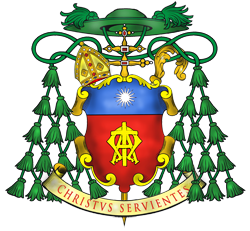
Coat of arms of Monsignor Rodrigues
as Primate of the Lower Gallican Rite

The Merovingian Dynasty today represents the most noble of all houses in Christendom and arguably the most ancient. The dynastic house of David-Toulouse-Gévaudan also descends from King David. The dynasty today is highly active in charitable service and service to the church around the world, following in the footsteps of its ancestors. The Lower Gallican Rite not only perpetuates an intangible religious and cultural heritage of the Merovingian Dynasty, but also furthers the goal of service to others.