Showing posts with label Gallican Rite. Show all posts

Thursday, October 24, 2024

The Significance of the Royal Consecration of Sire Esteve IV: A New Chapter in the Gallican Tradition

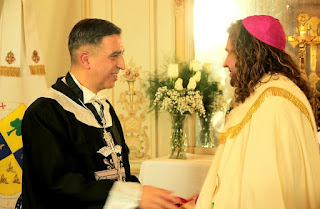
Sire Rubén (second from left)
at the event, seen wearing
the Merovingian crown, the
vestments of a deacon in ancient
French tradition, and the
scarlet cassock of a Cardinal.
By M. Derosier

PARIS 24 October 2024 (NRom) 

On the afternoon of October 23, 2024, a momentous event transpired within the ecclesiastical landscape of France, as the Gallican Rite of the Catholic Church affirmed the Royal Consecration of Sire Esteve IV as head of the Merovingian French Dynasty. This confirmation, which took place in Nice,  marks not only the second endorsement of His Most Eminent Royal Highness Sire Rubén (Esteve IV) in the French territory but also the first in the French territory by the Gallican Rite itself. This occasion also showcases a revival of a rich liturgical and cultural heritage, drawing attention to the intricate interplay between religion, monarchy, and national identity in history France.

The Gallican Rite, also known as the Hispano-Gallican Rite, is a tradition steeped in history, with origins from the Greco-Antioch Eastern Church in France and Spain. It even formed the basis for the eventual Anglican Rite. And, it was formally restored in 2021 under the spiritual leadership of the United Roman-Ruthenian Church and the temporal protection of the Merovingian Dynasty. This restoration signifies a significant commitment to rekindling the unique liturgical expressions and governance structures that characterized the French Church before the upheavals of the 18th century. 

Sire Rubén, who is not only the head of the Merovingian Dynasty but also Crown Cardinal of France within the Roman-Ruthenian Sacred College of Cardinals, embodies this duality of sacred authority and royal lineage. His elevation to such a significant ecclesiastical position accentuates the historical narrative of the French monarchy's close ties to the Church—a connection that remains deeply embedded in the collective consciousness of the French people, both in France and the diaspora around the world.

Moreover, this event invites reflection on the role of monarchy within the modern religious landscape. The intertwining of royal and ecclesiastical authority can be seen as a reaffirmation of the principles of governance that emphasize the divine right of kings. Sire Rubén's leadership, recognized by many ecclesiastical authorities around the world, serves as a potent symbol of this confluence, suggesting a path forward that honors both the past and the evolving needs of the faithful.

In an era marked by rapid societal changes and challenges to traditional structures, the reaffirmation of the Gallican Rite and the royal consecration of Sire Esteve IV also prompt a reevaluation of national identity within the context of faith. The ecclesiastical recognition of a royal figure within its ranks can serve to bridge divides, fostering a sense of belonging that transcends individual beliefs, while simultaneously honoring the rich history of ancient France.

This consecration of Sire Esteve IV is not merely a ceremonial act but a profoundly deep statement regarding the future of the Gallican Rite, the Merovingian Dynasty, and their roles within the broader  Christian community. It is a testament to the resilience of the Gallican Rite and the enduring significance of the ancient French monarchy. It invites all stakeholders—clergy, laity, and the broader community—to engage in a renewed dialogue about the intersections of faith, tradition, and identity in an ever-evolving world. The restoration of the Gallican Rite, coupled with the royal endorsement of Sire Esteve IV, heralds a new chapter that promises to enrich the spiritual landscape of France and the French diaspora, inspiring future generations to explore the depths of their heritage with renewed vigor and understanding.

Sunday, March 5, 2023

New Lectionary and Table of Verses and Prayers Released for the Catholicate

By Jean DuBois

FIRENZE-NUOVA ROMA 5 March 2023 (NRom)

A new lectionary and table of verses and prayers have been approved by His Holiness the Papa-Prince of Rome-Ruthenia for the Gallo-Russo-Byzantine Catholicate, for use with the Gallo-Russo-Byzantine and Anglican-Byzantine Rite, as well as optionally for the Anglo-Roman and Gallo-Roman Rites. The books follow the liturgical calendar of the Imperial Roman Church and maintain the spiritual tradition and ethnic heritage of the Apostolic See of Sts. Stephen and Mark. 

Papa Rutherford I said, "This work represents a significant milestone for the Apostolic See of Sts. Stephen and Mark. No longer are we arbitrarily tied to what groups like the Vatican Church did in the past. Rather, we now stand on our own feet as an autocephalous church equal to all others and neither second nor subservient to anyone other than God. We have separated the wheat from the chaff. We do not worship the past, but march forward confidently in faith as we carry the religion and ethnic heritage into the future." 

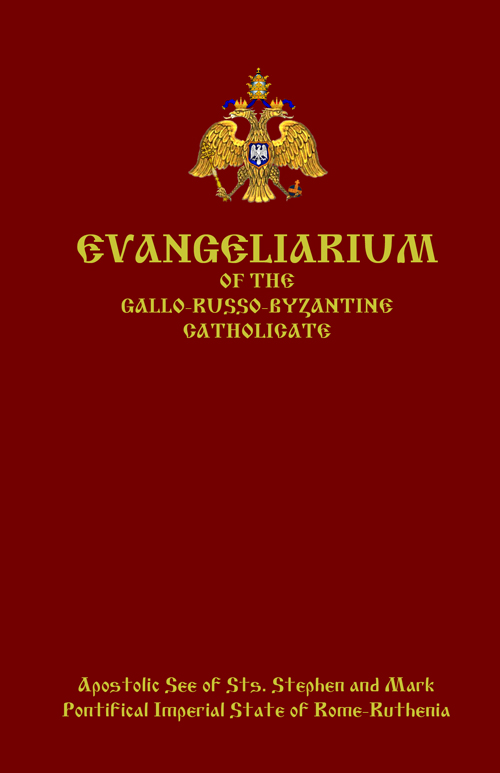
The Book of Gospels (shown) is available to clergy of the Imperial Roman Church and can be made in a variety of sizes to accommodate metallic Gospel covers. 


Wednesday, October 26, 2022

Enthronement of Gallican Primate at Buenos Aires Liturgy

By Jean DuBois

FIRENZE-NUOVA ROMA 26 October 2022 (NRom)

Videos have been released by the Royal Merovingian Dynasty of the solemn enthronement of His Reverence the Most Reverend Alejandro Rodrigues as Archbishop of Lyons and Primate of the Gallican Rite of the Catholic Church. The Gallican Rite, of Greek and Antiochean origins, is part of the spiritual structure of the Imperial Roman Church (within the Gallo-Russo-Byzantine Catholicate) and the temporal leadership of the Merovingian Dynasty under His Most Christian Majesty Esteve IV (Don Rubén Alberto Gavaldá). The liturgy according to the Gallican Rite was celebrated by His Excellency Monsignor Carlos Vich y Pizarro, Capitular Bishop of the Patriarchal Chapter. 

The enthronement took place on the feast of the Assumption, 15 August, earlier this year, following the formal consecration and coronation of Don Rubén as head of the Merovingian Dynasty. Archbishop Rodrigues is also a Capitular Archbishop of the Patriarchal Chapter of the Pontifical Court. The Gallican Rite is an historic part of the patrimony of the Merovingian Dynasty and is a minority intangible cultural heritage that the dynasty protects and preserves today. Members of the Gallican Rite regularly serve the poor of Buenos Aires and many other locations. 


Wednesday, April 27, 2022

Concordat Strengthens Religious, Historical Work


By Jean DuBois 

FIRENZE-NUOVA ROMA 27 April 2022 (NRom)

The Pontifical Household of the Imperial Roman Church (Gallo-Russo-Byzantine Catholicate and Anglican Patriarchate of Rome) and the Pontifical Roman State recently signed a concordat with the Royal Merovingian Dynasty. Once the rulers of France before Charlemagne, the Merovingian household is one of the most ancient royal and noble families in the world today. The Merovingian dynasty is also the temporal head of the Gallican Rite of the Catholic Church, which, in addition to having its own Primate, is under the spiritual leadership of the Gallo-Russo-Byzantine Catholicate. This concordat, signed by Rutherford I and Don Rubén de Gévaudan, builds on an established and long-lasting partnership for religious service, humanitarian work, and the preservation of the traditions and history of our common ethnic heritage.

Friday, January 7, 2022

Lower Gallican Rite of the Catholic Church Re-Established - New Primate Appointed

By Jean DuBois

FIRENZE-NUOVA ROMA 07 Jan 2022 (NRom)

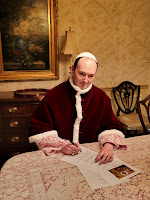
Rutherford I signing
the Concordat
Recently His Holiness Papa Rutherford I, Prince of Rome signed a concordat between the Apostolic See and the Royal Merovingian Dynasty and issued an Apostolic Constitution formally reestablishing the Lower Gallican Rite of the Catholic Church. The re-established rite is under the spiritual protection of the Anglican Patriarchate of Rome and the temporal leadership of His Christian Majesty Don Esteve IV Rubén Alberto, head of the ancient Merovingian Dynasty. 

His Excellency Alejandro Paulo Rodrigues, Capitular Bishop of Saint Stephen in the pontifical court, was named by the Archfather as Primate of the Lower Gallican Rite, with the associated title of Archbishop of Lyon, the most the most ancient See in France.

The Gallican Rite is not a single rite of the Church, but instead is an ancient collection that came into use at least before the 5th century and is associated primarily with Roman Gaul and Western Francia (modern-day France). The neighbouring Iberian Rite was similarly used from the 5th century in Roman Hispania (modern-day Spain). The Iberian Rite was so linked with the Gallican Rite that they are often referred to jointly as Hispano-Gallican. In fact, the territories of the Merovingian Dynasty are widely associated with Spain as well. The house of Gévaudan itself, for example, became linked to the thrones of Barcelona, Aragón, and Castile y León. The Italo-Burgundian House of Ivrea, to which the Anglican Patriarchate of Rome is heir in Imperial Italy, shared a similar history, holding those same thrones. 
Don Esteve IV Rubén Alberto (left) and
Monsignor Alejandro Rodrigues, Archbishop of Lyons (right)

Also used to describe the Rite is the term Gallo-Roman. The Gallican Rite is also associated with Italy, particularly the areas of Piemonte and Lombardia in the north, as well as Tuscany and Sicily/Naples -- all areas that were historically associated with France.
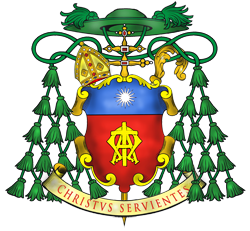
Coat of arms of Monsignor Rodrigues
as Primate of the Lower Gallican Rite

The Merovingian Dynasty today represents the most noble of all houses in Christendom and arguably the most ancient. The dynastic house of David-Toulouse-Gévaudan also descends from King David. The dynasty today is highly active in charitable service and service to the church around the world, following in the footsteps of its ancestors. The Lower Gallican Rite not only perpetuates an intangible religious and cultural heritage of the Merovingian Dynasty, but also furthers the goal of service to others.