Holy Apostolic SeeUnited Roman-Ruthenian Church

News of the Holy Apostolic See

Il Nunzio Romano-Ruteno

Римско-Русскій Вѣстникъ

The Roman-Ruthenian Herald is the journalistic service of the United Roman-Ruthenian Church and the Pontifical Imperial State of Rome-Ruthenia.

Showing posts with label New Roman Communion. Show all posts

Monday, February 28, 2022

Anglican Patriarchate, Successor to Rome, also Apostolic Descendant of Russian Orthodox

His Holiness Patriarch
Nikon of Moscow
By Jean DuBois

FIRENZE-NUOVA ROMA 28 February 2022 (NRom)

The Anglican Patriarchate of Rome unites the West and East through its heritage. As a major part of that, the patriarchate is actually an Apostolic descendant of the Russian Orthodox Church. This important element of the Apostolic Succession of the Anglican Patriarchate of Rome not only provides a concrete ecclesiastical link between Western Rome and that great successor to the Eastern Roman Empire, the Russian Empire, but also demonstrates the universality of the Apostolic, Catholic, and Orthodox Christian Faith.

The Anglican Patriarchate of Rome, as the Apostolic See and temporal successor to the Pontifical States (State Pontificio), is the modern ecclesiastical successor to the Roman Empire. Yet its Apostolic Succession (direct lineage from the Apostles) is not only Roman, but from the Eastern church, including Greek/Byzantine, Syrian/Chealdean (in modern day Syria and Iraq), and Antioch. One of the most important lines of Eastern Apostolic succession is from Nikon, Patriarchate of Moscow and All Rus, head of the Russian Orthodox Church who served from 1652 to 1666. This has particular importance since the Russian Empire was considered a “New Rome” and successor to the Eastern Roman Empire. In fact, the church came to Kievan Rus (the precursor to the Russian Empire, centred in modern-day Ukraine) via the Greek territories in the mission work of Saint Andrew the Apostle. Later, as the Russian Empire developed from a collection of principalities and states, the centre of the church transferred from Kiev to Moscow.

Metropolitan Makariy
of Moscow, in the
Apostolic Succession of
the Patriarchate. Last
Metropolitan of 
Moscow in the Russian
Empire before the
Bolshevik Revolution. 
Patriarch Nikon was of particular importance in the history of the Eastern Church and the Russian Empire. He was very close to the Tsar, Aleksey Mikhaylovich. With the support of the Tsar and in consultation with the Greek Orthodox leadership and scholars, he undertook reforms of the Russian liturgy, leaving his mark on the faith through the present day. Despite the conflict with the Western Church, he took a much more canonical and conciliatory stance. In opposition to some in church leadership, this included making it clear that Latin Rite Christians who converted to Russian orthodoxy did not need to be baptized again. Also, while the Tsar was away from Moscow military campaign, Patriarch Nikon was left in charge of the state at home.

Indeed, this important and concrete ecclesiastical link between Western Rome and the Russian Empire as a successor to the Eastern Roman Empire, the Russian Empire, should serve as a reminder that Christ unites us all. Ut unum sint - may we all be one.

Friday, February 18, 2022

How the New Roman Communion Unites West and East

FIRENZE-NUOVA ROMA 18 Feb. 2022 (NRom)

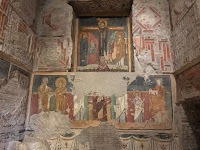
Inside the Basilica of Santa
Maria Antiqua, Rome

While the world continues segregating itself and causing division, Christ’s Holy Church works in the opposite direction, continually building unity. This is the mission of the New Roman Communion.

The New Roman Communion comprises the Anglican Patriarchate of Rome and the churches of all bishops in communion with the Florentine-Roman Apostolic See, regardless of liturgical rite. It takes its name from the historical position of Florence as the second New Rome in the Renaissance after Constantinople and before Moscow and the Russian Empire. It is headed by the Papa-Prince of Rome. Although it has much shared heritage and authority, the New Roman Communion is administratively distinct from the Roman Communion, which is headed by the Pope-Bishop of Rome at the Vatican.

The New Roman Communion is both Western and Eastern, following the heritage of the Roman Empire to which it is ecclesiastical successor. Both the Anglican Rite and its precursor, the Franco-Spanish-origin Gallican Rite of the Catholic Church are contained within it. Traditional Roman rites, as well as Melkite, Byzantine, Ruthenian, Russian and other Eastern Rites are permitted by its laws. In fact, the Apostolic Succession of the Anglican Patriarchate is not only Roman and Anglican, but also Melkite, Chaldean, and Russian. The universal Christian unity of this rich, mixed heritage of West and East is displayed especially during certain solemn masses of the Papa-Prince through the inclusion of a Byzantine Deacon and an Eastern Deacon who sing the Gospel in Greek and Russian or another Slavic language respectively following its customary singing in Latin. And, scholars often discuss the Eastern Rite influences seen within the Gallican and Anglican Rites.

Yet the similarities and connections do not end there. The historic Roman seat of the Papa-Prince, the Most Holy Patriarchal Basilica of Santa Maria Antiqua, located within the Roman Forum, was considered the Sistine Chapel of the Early Church and was for a time the seat of the Bishop of Rome. The basilica was constructed during the so-called Byzantine era of Rome and boasts an excellent collection of Byzantine frescoes. A massive restoration project just ended a few years ago.

Christ came to unite the world, and this is the ongoing mission of the New Roman Communion. This mission is a modern continuation of the ancient mission of the church. Just as the Apostles went to both the East and the West to spread the Gospel, and just as the Roman Empire extended both to the East and the West, the New Roman Communion today serves as a welcome place for Christians of all traditional liturgical rites.